Issue 1 — November 1, 2005
Hi All! It's been a really exciting and challenging year so far. It's definitely a lot more work than any one tells you to start your own business. But when you have a vision and a dream to get all kids to eat and eat properly and well, then you must persevere. This also holds true for getting kids to talk especially those with apraxia… which is my second passion. I am so fortunate to have so many supportive families in my corner. They truly have been inspirational to me in their support and understating in dealing with growing pains. Also, I want to make sure everyone knows that none of this would have even become a reality or would grow without the talent and constant support of my husband Paul. He is responsible for my amazing web site (I still bring it up just to stare at it as I can’t believe it’s mine!). He gets a good laugh at that.
As this is the first attempt of a creating an informational and fun newsletter, it may be lacking. I ask that all of you please bear with me as I figure out what works and what doesn’t. I request that everyone who drop me a line or more for feedback. I would love to have a section for questions and answers from parents and hopefully professionals, testimonials, and comments/critiques. This newsletter is intended to provide additional information for families that need support and help in their daily struggles so parental input is essential.
To bring everyone up to date, I turned my full attention to developing and expanding S.M.I.LE.S. in April of this year. It has been going very well overall. I have so much more work to do to create the service center of my dreams, but I have a good start. Paul is vital to the operation and has really delivered on the web site and new business card. He has so many other plans I can’t wait to initiate. We are at a crucial point in that I now need to add to the SLP staffing which will be a significant challenge due to the tremendous shortage of professional in the field. It will be a completely different work environment and experience so hopefully I will be able to find the right people to join in my endeavors.
I thank all of you for subscribing and waiting patiently for the release of the newsletter. I look forward to making this a wonderful informational piece with all of you.
Warmest regards,
Tara
--------------------------------------------------------------------------------------------------------------
Did you know:
- 20% of the general population of children have some level of feeding disorder
- 80% of children with a disability have feeding difficulties/disorders
- 1 in 400 children is Austic Spectrum Disorder
- 1 in 800 children born have Down syndrome
Some Signs and symptoms of a feeding problem:
- being a picky eater
- eating primarily one or 2 types of food such as crunchy (chips, pretzels, ) soft (pasta, cooked veggies, French fries, chicken nuggets, etc)
- Difficulty transitioning form one food to another—i.e., stage 2 to stage 3, stage 3 to table foods
- Eating only a couple of bites and them saying full
- Drinking preferred over eating
When what should happen:
In typical development your child should be doing the following:
9-12 months:
- identifying 2 body parts on self,
- saying ‘mama’ or ‘dada’ meaningfully
- cover and uncovers face during peek-a-boo
15-18 months:
- plays ball with adults
- completes 2 requests with one object (i.e., pick up your cup and put it on the table)
- uses consonants t, d, h, n
21-24 months:
- pushes a stroller or shopping cart
- puts toys away on request
- chooses one object from at least five in the same area
- uses two-word phrases frequently
33-36 months:
- uses doll as playmate
- responds appropriately to wh questions (i.e. what is your name?, where is mommy?)
- converses in sentences
*Information taken form the Rosetti Infant-Toddler Language Scale—A measure of communication and interaction
If your child is not meeting any of the above milestones, please search out assistance and get your child evaluated by a speech-language pathologist. They are the only professionals that will be able to accurately state if your child is in fact experiencing any speech and language delays. IT is better to have a child evaluated and not need services than to need services and wait to have them evaluated. The earlier services can be initiated the better off your child will be as the first 3 years are very crucial in development. In addition, you would be able to tap into your regions early intervention program for services provided through state funding until the age of 3. Each state and area is different in the services available so be sure to check to see what is available before immediately going thought you insurance company. It may be that you won’t need your personal insurance at this early time if the state’s funding allows for weekly visits.
What’s New:
As an update on what’s new in the therapy world, I have taken information provided by families I currently work with as well as my own experiences to share with you. The newer recessed lid cup form Talk Tools has received above average reviews. One family shared that they really like it except that some lids for open cup drinking can be quite loose and will pop out if thrown. This does not go for all lids so check yours carefully.
Also from talk Tools, the consensus seems to be that the new version of the infa-trainer cup they are carrying has 2 problems. It seems it is both difficult for a child to hold as it is too big for little hands and the lip or rim is too thick for little mouths.
The Lip Blok for ARK Therapeutic Services, inc. is still the best on the market. You must cut the top down so the child can only get their lips on it, but it says in place regardless of the effort exerted to move it. This is an excellent training tool for prohibiting biting and tongue usage on the straw (both of which are hard habits to break!) There is a lip block from Talk Tools tat fits onto crazy straws, but kids can push this one down quite easily with their lips while drinking. I prefer the Lip Blok from ARK even though it doesn’t fit onto higher level straws (crazy straws). I look for straws that have characters on them (like Bob the Builder and Dora from Kroger Grocery stores) or others that you are able to cut down to prevent the usage of teeth and tongues on the straws as the tasks become more challenging.
I have found that using thera band tied across the bottom of a chair is very effective in keeping busy feet still. It gives them something to do with their legs while assisting them in attending to tasks. Many thanks out to parent Michele Wilson for the tip!!
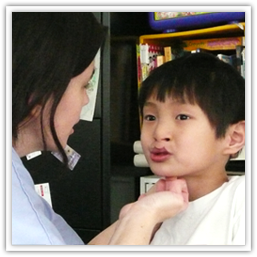
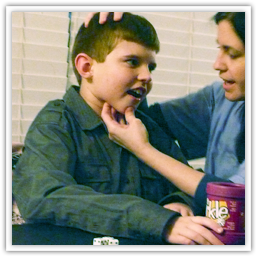
Another tip for busy bottoms/bodies is sitting on a Movin’ Sit wedge (found in Integrations catalog) has greatly helped many little one who need to be constantly moving or input. Actually many kids that don’t seem to fit the bill for the sensory input are actually enjoying sitting on the wedge. I have kids actually carry it around to sit on. It has allowed some of my kids to actually become more vocal (primarily apraxic kids), get out better sounds, and attend to the tasks at hand much longer so tactile-kinesthetic input can be appropriately delivered to their oral musculature (I generally utilize the PROMPT technique).
Please give feedback to any new or old products that you’ve had success with or absolutely do not recommend. We are all looking out for the best interest of the kids! Remember, no 2 children are built exactly alike, so even if one item does not work well for one child, it doesn’t mean it won’t work for yours!
Subscribe today! |